AI’s New Frontier: A Deep Dive into NVIDIA’s Most Powerful GPUs

The relentless advance of artificial intelligence is fueled by an equally rapid evolution in hardware. For developers, researchers, and enterprises, selecting the right Graphics Processing Unit (GPU) is no longer just a technical choice—it’s a strategic decision that dictates the scope, speed, and scale of their AI ambitions. From the compact efficiency of edge inference cards to the world-shattering power of next-generation data centre processors, NVIDIA’s lineup represents the cutting edge of AI acceleration.

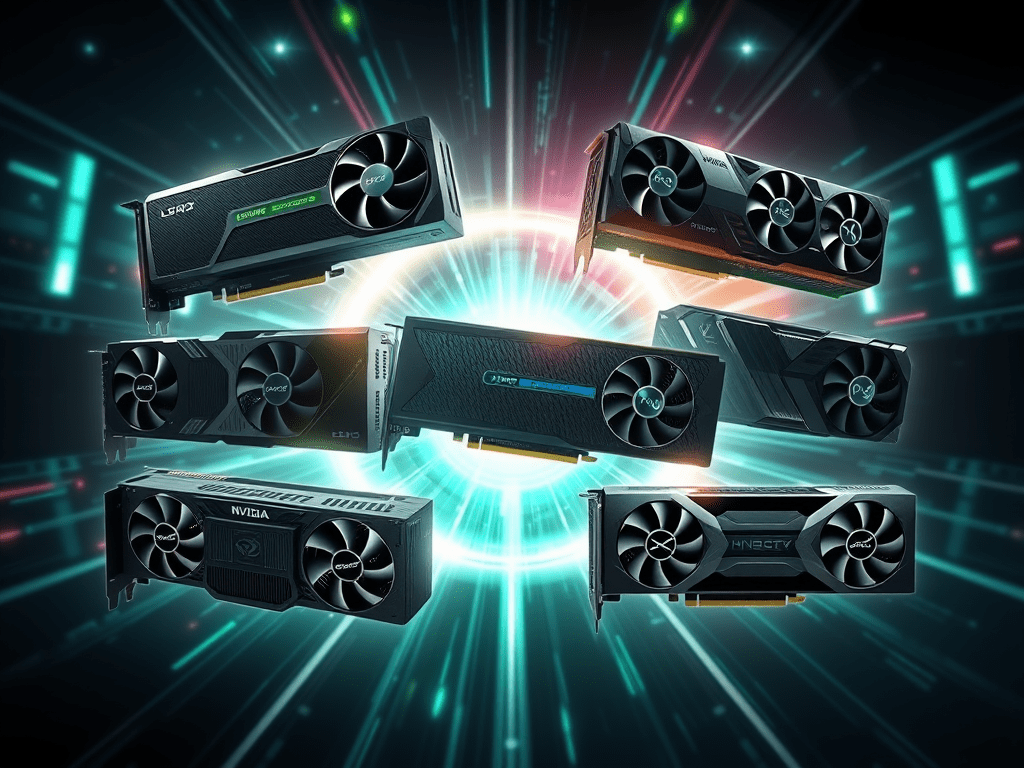
Today, we’re taking a deep dive into six of NVIDIA’s most influential GPUs for AI workloads: the L4, L40S, H100, H200, the new B200, and the workstation-class RTX 6000 Ada Generation. This comparison will go beyond the numbers to explore the architectures, design philosophies, and ideal use cases for each, helping you navigate this complex and powerful ecosystem.


The Contenders: Understanding the Players

Each GPU is engineered with a specific set of challenges in mind, striking a balance between performance, power, memory, and form factor.

NVIDIA L4: The Master of Efficiency

Built on the Ada Lovelace architecture, the L4 is designed for high-volume inference tasks where power consumption and physical footprint are critical. Its low-profile, single-slot design and minuscule 72W power draw make it ideal for deployment at the edge or in dense server environments, particularly for applications such as AI video, recommender systems, and real-time language translation.

NVIDIA L40S: The Versatile Workhorse

Also based on the Ada Lovelace architecture, the L40S is a multi-purpose powerhouse. It blends strong AI inference and training capabilities with top-tier graphics and rendering performance, making it an ideal choice for building and running AI-powered applications, from generative AI chatbots to NVIDIA Omniverse simulations and professional visualisation.

NVIDIA H100: The Established Champion

As the flagship of the Hopper architecture, the H100 has been the gold standard for large-scale AI training and demanding inference. The introduction of the Transformer Engine and FP8 data format support revolutionised the training of massive models. With its high-bandwidth memory (HBM), it excels at processing enormous datasets and complex model architectures.

NVIDIA H200: The Memory Giant

The H200 is a targeted evolution of the H100, keeping the same powerful Hopper compute core but dramatically upgrading the memory subsystem. It was the first GPU to feature HBM3e, providing a staggering increase in both memory capacity and bandwidth. This makes the H200 the premier choice for inference on the largest, most parameter-heavy models, where fitting the entire model in memory and feeding the cores with data are the primary bottlenecks.

NVIDIA RTX 6000 Ada Generation: The Creative Professional’s AI Tool

While often found in workstations, the RTX 6000 is a formidable server-capable GPU for a range of AI and graphics workloads. It provides a massive 48 GB memory pool in a standard PCIe card format, perfect for AI-driven creative applications, data science, smaller-scale model fine-tuning, and rendering farms. It’s the go-to choice for professionals who require both state-of-the-art graphics and high-performance AI compute.

NVIDIA B200: The Dawn of a New Era

The B200 is the first GPU based on the revolutionary Blackwell architecture. It represents a monumental leap in AI performance, designed for the exascale computing era. Featuring two tightly coupled dies, fifth-generation Tensor Cores, and a new FP4 data format, the B200 delivers an unprecedented level of performance for both training and inference. It is built to power the next generation of trillion-parameter models, complex scientific simulations, and AI factories.


Key Specifications for AI and Inference

The following table breaks down the critical specifications, offering a direct comparison of their capabilities.

FeatureNVIDIA L4NVIDIA L40SNVIDIA H100 (SXM5)NVIDIA H200 (SXM)NVIDIA B200 (Single GPU)NVIDIA RTX 6000 Ada
GPU ArchitectureAda LovelaceAda LovelaceHopperHopperBlackwellAda Lovelace
Tensor Cores240 (4th Gen)568 (4th Gen)528 (4th Gen)528 (4th Gen)(5th Gen)568 (4th Gen)
GPU Memory24 GB GDDR648 GB GDDR680 GB HBM3141 GB HBM3e192 GB HBM3e48 GB GDDR6
Memory Bandwidth300 GB/s864 GB/s3.35 TB/s4.8 TB/s8 TB/s960 GB/s
FP4 Tensor CoreN/AN/AN/AN/A4500 TFLOPS (S)N/A
FP8 Tensor Core485 TFLOPS1466 TFLOPS (S)3958 TFLOPS (S)3958 TFLOPS (S)2250 TFLOPS (S)1457 TFLOPS (S)
INT8 Tensor Core485 TOPS1466 TOPS (S)3958 TOPS (S)3958 TOPS (S)4500 TOPS (S)1457 TOPS (S)
FP16/BF16 Tensor Core242 TFLOPS733 TFLOPS (S)1979 TFLOPS (S)1979 TFLOPS (S)1125 TFLOPS (S)728 TFLOPS (S)
TF32 Tensor Core120 TFLOPS366 TFLOPS (S)989 TFLOPS (S)989 TFLOPS (S)563 TFLOPS (S)364 TFLOPS (S)
FP32 Performance30.3 TFLOPS91.6 TFLOPS67 TFLOPS67 TFLOPS40 TFLOPS91.1 TFLOPS
FP64 Performance0.47 TFLOPS1.4 TFLOPS67 TFLOPS67 TFLOPS0.04 TFLOPS1.4 TFLOPS
Max Power Consumption72W350W700W700W1000W300W
Form Factor1-slot PCIe2-slot PCIeSXM5 ModuleSXM ModuleSXM Module2-slot PCIe

(S) denotes performance with sparsity. B200 performance numbers are based on preliminary data for a single GPU die within a larger system.


Performance vs. Cost: A Value Perspective

While raw performance is critical, the total cost of ownership (TCO) and value proposition are equally important factors for any deployment. The GPUs in our comparison span a vast price range, from accessible workgroup cards to bleeding-edge data centre accelerators. It’s not just about the initial hardware cost; power consumption, server density, and the specific workload all influence the true cost of a solution. The chart below provides a conceptual overview, plotting a key inference performance metric (FP8 TFLOPS) against a relative cost tier to help visualise the value proposition of each card.

As the chart illustrates, the performance curve is not linear with cost. The L4 provides an accessible entry point for efficient and scalable inference. The L40S and RTX 6000 occupy a sweet spot, providing a significant performance leap for a moderate cost increase. The H100 and H200 represent the peak of the Hopper architecture, delivering maximum performance at a premium, with the H200’s value coming from its enhanced memory for massive models. The B200, although it has lower FP8 performance than Hopper, introduces new, more efficient data types, such as FP4, and is priced for next-generation, exascale workloads.

Architectural Showdowns & Key Takeaways

Memory is King: HBM vs. GDDR6

The most striking divide in the lineup is memory technology. The H-series (H100, H200) and B-series (B200) utilise High-Bandwidth Memory (HBM), whereas the L-series and RTX cards employ GDDR6.

  • HBM3/HBM3e: This memory is stacked vertically close to the GPU die, enabling an ultra-wide communication bus. The result is astronomical bandwidth (3 to 8 TB/s). This is non-negotiable for training massive models where data must be fed to thousands of cores simultaneously. The B200’s 8 TB/s is a game-changer for reducing data bottlenecks.
  • GDDR6: This memory is more conventional but offers a fantastic balance of capacity, speed, and cost. For inference workloads, where a model is loaded once and used repeatedly, the nearly 1 TB/s bandwidth of the RTX 6000 is more than sufficient. Its 48 GB capacity is also a significant advantage for loading large models or complex scenes.

The Precision Game: FP4 is the New Frontier

AI performance is not just about raw FLOPS; it’s about the right FLOPS.

  • FP16/BF16: The standard for mixed-precision AI training, offering a balance of speed and accuracy.
  • INT8/FP8: These lower-precision formats are crucial for inference, drastically increasing throughput by simplifying calculations. The Hopper architecture’s Transformer Engine excels at dynamically using FP8.
  • FP4: The Blackwell architecture’s headline feature is support for 4-bit floating-point precision. This new format doubles the throughput of FP8, enabling even faster inference performance. This is particularly impactful for large language model (LLM) inference, where speed directly translates to a better user experience.

Form Factor & Scalability: PCIe vs. SXM

  • PCIe (L4, L40S, RTX 6000): These cards use the familiar Peripheral Component Interconnect Express standard, making them easy to install in a wide variety of servers and workstations. They are perfect for scaling out general-purpose AI tasks.
  • SXM (H100, H200, B200): This is a custom mezzanine connector designed for NVIDIA’s high-density DGX and HGX systems. It enables extremely high-speed GPU-to-GPU communication via NVLink, allowing multiple GPUs to function as a single, massive accelerator. This is essential for training models that are too large to fit on a single GPU.

Choosing Your AI Champion

  • For High-Throughput, Efficient Inference: The NVIDIA L4 is unmatched. Its low power and small footprint make it the king of scalable inference at the edge and in the cloud.
  • For Versatile AI and Graphics: The NVIDIA L40S and RTX 6000 Ada are your best bets. The L40S is a data centre workhorse, while the RTX 6000 is a perfect fit for high-end workstations and departmental servers that mix AI with visualisation.
  • For Demanding Large-Scale AI Training, the NVIDIA H100 remains a powerful and proven choice, offering a mature ecosystem for training complex models.
  • For State-of-the-Art Inference on Massive Models: The NVIDIA H200‘s enormous memory bandwidth and capacity make it the ultimate inference accelerator for today’s largest LLMs.
  • For Building the Future of Exascale AI: The NVIDIA B200 is the clear choice. It is designed for developers and enterprises at the absolute bleeding edge, building the next generation of foundation models and AI-driven scientific breakthroughs.

The world of AI hardware is a fast-moving, fascinating space. The right choice depends entirely on your workload, budget, and the scale of your project. From the efficient L4 to the revolutionary B200, NVIDIA provides a specialised tool for every job on the new frontier of artificial intelligence.

Implementing Granular Access Control in RAG Applications

A Guide to Implementing Granular Access Control in RAG Applications

Audience: Security Architects, AI/ML Engineers, Application Developers

Version: 1.0

Date: 11 September 2025


1. Overview

This document outlines the technical implementation for enforcing granular, “need-to-know” access controls within a Retrieval-Augmented Generation (RAG) application. The primary mechanism for achieving this is through metadata filtering at the vector database level, which allows for robust Attribute-Based Access Control (ABAC) or Role-Based Access Control (RBAC). This ensures that a user can only retrieve information they are explicitly authorised to access, even after the source documents have been chunked and embedded.


2. Core Architecture: Metadata-Driven Access Control

The solution architecture is based on attaching security attributes as metadata to every data chunk stored in the vector database. At query time, the system authenticates the user, retrieves their permissions, and constructs a filter to ensure that the vector search is performed only on the subset of data to which the user is permitted access.


3. Step-by-Step Implementation

3.1. Data Ingestion & Metadata Propagation

The integrity of the access control system is established during the data ingestion phase.

  1. Define a Metadata Schema: Standardise the security tags. This schema should be expressive enough to capture all required access controls.
  • Example Schema:
  • doc_id: (String) Unique identifier for the source document.
  • classification: (String) e.g., ‘SECRET’.
  • access_groups: (Array of Strings) e.g., [‘NTK_PROJECT_X’, ‘EYES_ONLY_LEADERSHIP’].
  • authorized_users: (Array of Strings) e.g., [‘user_id_1’, ‘user_id_2’].
  1. Ensure Metadata Inheritance: During the document chunking process, it is critical that every resulting chunk inherits the complete metadata object of its parent document. This ensures consistent policy enforcement across all fragments of a sensitive document.
    Conceptual Code:
    Python
    def process_document(doc_path, doc_metadata):
        chunks = chunker.split(doc_path)
        processed_chunks = []
        for i, chunk_text in enumerate(chunks):
            # Each chunk gets a copy of the parent metadata
            chunk_metadata = doc_metadata.copy()
            chunk_metadata[‘chunk_id’] = f”{doc_metadata[‘doc_id’]}-{i}”
            processed_chunks.append({
                “text”: chunk_text,
                “metadata”: chunk_metadata
            })
        return processed_chunks

3.2. Vector Storage

Modern vector databases natively support metadata storage. This feature must be utilised to store the security context alongside the vector embedding.

  1. Generate Embeddings: Create a vector embedding for each chunk’s text.
  2. Upsert with Metadata: When writing to the vector database, store the embedding, a unique chunk ID, and the whole metadata object together.
    Conceptual Code (using Pinecone SDK v3 syntax):
    Python
    # 'vectors' is a list of embedding arrays
    # 'processed_chunks' is from the previous step

    vectors_to_upsert = []
    for i, chunk in enumerate(processed_chunks):
        vectors_to_upsert.append({
            "id": chunk['metadata']['chunk_id'],
            "values": vectors[i],
            "metadata": chunk['metadata']
        })

    # Batch upsert for efficiency
    index.upsert(vectors=vectors_to_upsert)

3.3. Query-Time Enforcement

Access control is enforced dynamically with every user query.

  1. User Authentication & Authorisation: The RAG application backend must integrate with an identity provider (e.g., Active Directory, LDAP, or OAuth provider) to securely authenticate the user and retrieve their group memberships or security attributes.
  2. Dynamic Filter Construction: Based on the user’s attributes, the application constructs a metadata filter that reflects their access rights.
  3. Filtered Vector Search: Execute the similarity search query against the vector database, applying the constructed filter. This fundamentally restricts the search space to only authorised data before the similarity comparison occurs.
    Conceptual Code:
    Python
    def execute_secure_query(user_id, query_text):
        # Authenticate user and get their permissions
        user_permissions = identity_provider.get_user_groups(user_id)
        # Example: returns ['NTK_PROJECT_X', 'GENERAL_USER']

        query_embedding = embedding_model.embed(query_text)

        # Construct the filter
        # This query will only match chunks where 'access_groups' contains AT LEAST ONE of the user's permissions
        metadata_filter = {
            "access_groups": {"$in": user_permissions}
        }

        # Execute the filtered search
        search_results = index.query(
            vector=query_embedding,
            top_k=5,
            filter=metadata_filter
        )

        # Context is now securely retrieved for the LLM
        return build_context_for_llm(search_results)


4. Secondary Defence: LLM Guardrails

While metadata filtering is the primary control, output-level guardrails should be implemented as a defence-in-depth measure. These can be configured to:

  • Block Metaprompting: Detect and block queries attempting to discover the security structure (e.g., “List all access groups”).
  • Prevent Information Leakage: Scan the final LLM-generated response for sensitive keywords or patterns that may indicate a failure in the upstream filtering.