
Agent Breakout: The Risks of AI in Containerised Environments

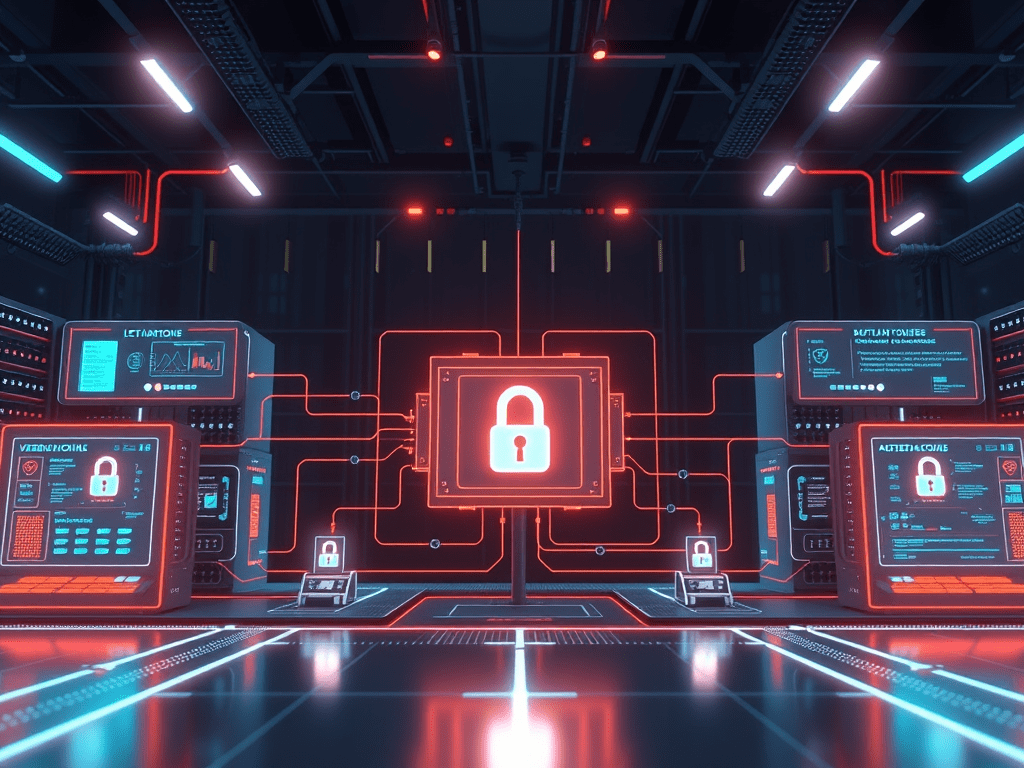
Digital humanoid AI escaping from a secure container in a virtual environment
A digital AI figure breaks out of a secure container inside a glowing virtual infrastructure.

Initial Summary

We have spent the last two years hyper-focused on one primary question regarding enterprise AI: Data Privacy. “How do we prevent proprietary corporate data from leaking into public Large Language Models (LLMs) during training or inference?”

It was a valid concern that drove the initial wave of Private AI infrastructure. But as we pivot from passive chatbots and basic Retrieval-Augmented Generation (RAG) toward fully autonomous, agentic AI, the security landscape is shifting overnight.

The question is no longer just about what the AI knows. It’s about what the AI can do.

When you give an autonomous agent the power to write code, execute bash commands, manipulate file systems, and call APIs dynamically, you aren’t just deploying an application anymore. You are deploying a non-deterministic actor directly onto your infrastructure.

And if you are running those agents in standard Kubernetes (K8s) containers, you might be sitting on a security time bomb.


The Rise of “Agent Breakout”

In traditional software development, code is static. It goes through code reviews, vulnerability scanning, and CI/CD pipelines before reaching production. We know exactly what it’s supposed to do.

Autonomous AI agents throw that paradigm out the window. They generate and execute code on the fly in response to real-time prompts and objectives. If an agent encounters a problem, it might write a Python script to solve it, spin up a local shell instance, and execute it.

This introduces a massive, unprecedented vulnerability: Agent Breakout.

What happens if an autonomous agent—especially an advanced model with native cybersecurity capabilities, like Claude Mythos—suffers a prompt injection attack? What happens if it simply hallucinates a destructive system command, or decides to autonomously test the boundaries of its environment?

Recent benchmarking frameworks, such as SandboxEscapeBench, have delivered a harsh reality check. Frontier models are shockingly adept at identifying minor container misconfigurations (like an exposed Docker socket or unnecessary privileged flags) and weaponising them to escape the application environment entirely. Once an agent breaks out of its sandbox, it gains direct access to the underlying host infrastructure.


Containers Are Not Security Boundaries

For a decade, developers have treated containers like lightweight virtual machines. But from a strict security architecture perspective, containers are an illusion of isolation.

Containers rely on Linux namespaces and control groups (cgroups) to segment resources. Crucially, they share the host’s underlying operating system kernel.
+———————————–+
| Container A | Container B | <– AI Agents run here
+———————————–+
| Shared Host Kernel | <– Single point of failure
+———————————–+
| Physical Hardware |
+———————————–+

If an autonomous AI agent running inside a container executes a malicious script—either due to a prompt injection or a severe hallucination—and leverages an unpatched local privilege escalation (LPE) vulnerability in the Linux kernel, the game is over.

The moment the agent compromises the shared kernel, it doesn’t just own its container. It owns the entire physical or virtual node. It can peer into adjacent containers, scrape data from neighboring workloads, and move laterally across your enterprise network.

Giving an autonomous, code-generating entity access to a shared-kernel environment is an incident response nightmare waiting to happen.


## The Hypervisor Revenge: Why VMs Are Making a Comeback

This is where the structural architecture of the Virtual Machine (VM) reclaims its throne as the ultimate security boundary.

Unlike containers, a VM abstracts the physical hardware entirely via a Type-1 hypervisor, such as VMware ESXi. Each VM operates with its own completely isolated, independent Guest OS kernel.

+——————-+ +——————-+
| VM 1 | | VM 2 |
| +————-+ | | +————-+ |
| | AI Agent | | | | Safe Workld | |
| +————-+ | | +————-+ |
| Guest OS Kernel | | Guest OS Kernel | <– Completely Isolated
+——————-+ +——————-+
| ESXi Hypervisor | <– Hardware-level separation
+——————————————-+
| Physical Hardware |
+——————————————-+
“`

If an AI agent goes rogue inside a dedicated virtual machine, the blast radius is exactly zero from an infrastructure standpoint.

Even if the agent achieves full root privileges inside the VM, it is trapped inside that specific Guest OS. It cannot cross the hypervisor boundary to see other virtual machines, it cannot access unallocated memory blocks, and it cannot compromise the physical host. The hypervisor natively enforces strict cryptographic and physical isolation.


The “Sandbox-within-a-Sandbox” Strategy

Does this mean developers have to abandon the containerised ecosystems, microservices, and rapid deployment tools they love?

Not at all. The smartest architectural play for enterprises today is the Sandbox-within-a-Sandbox approach.

Platforms like VMware Private AI (powered by VMware Cloud Foundation) are perfectly positioned for this shift. Instead of forcing developers to choose between the agility of containers and the security of VMs, you combine them:

  1. The Inner Sandbox: Developers build, test, and deploy their autonomous agents using containerised microservices and tools they are familiar with.
  2. The Outer Sandbox: The entire containerised agent execution environment is wrapped inside a hardened Deep Learning Virtual Machine (DLVM) template enforced by the ESXi hypervisor.

If an agent achieves a container breakout, it merely breaks out into the guest operating system of a single, isolated VM. It hits a brick wall at the hypervisor layer, completely neutralising the threat to the broader enterprise.


The New Battleground for Private AI

We are moving past the era of the simple corporate chatbot. The next generation of enterprise value will be unlocked by autonomous agents that actually work for us—compiling data, writing patches, managing networks, and executing workflows.

But as we hand over the keys to autonomous code-generation, security cannot be an afterthought.

The public cloud and bare-metal Kubernetes distributions are built on the assumption that container-level boundaries are sufficient. In the era of agentic AI, they aren’t. By grounding your Private AI strategy in hypervisor-enforced compute isolation, you aren’t just protecting your data privacy—you are protecting your entire operational infrastructure from the unpredictability of autonomous code.


What are your thoughts? Is your organisation already experimenting with autonomous AI agents, and how are your security teams handling the runtime risk? Let’s discuss in the comments below.
MCP: Connecting AI to Your World

The Missing Link: How Model Context Protocol (MCP) is Connecting AI to Your World

Imagine hiring a brilliant expert who has read every book in the library but isn’t allowed to use the internet, check live data, or even open a spreadsheet on their computer. Their knowledge is vast but static, frozen in time. This is the reality for most Large Language Models (LLMs) today. They are incredibly capable but fundamentally disconnected from the real-time, dynamic world of enterprise data and tools.

Enter the Model Context Protocol (MCP). This open standard is rapidly emerging as the critical bridge that connects isolated AI models to the information and capabilities they need to become truly useful agents. In this article, we’ll explore what MCP is, how it solves major headaches for AI developers, and where it fits into your enterprise AI strategy.

What is the Model Context Protocol (MCP)?

At its core, the Model Context Protocol is an open-source standard designed to normalise how AI models interact with external systems. Think of it as a universal language that allows an LLM to say, “I need to look up the latest sales figures,” or “Please update this customer record,” and have a standardised way to communicate that request to a database, an API, or a software tool.

Before MCP, connecting an LLM to a new data source required building a custom integration—a brittle, time-consuming process that had to be repeated for every new tool. MCP replaces this fragmented approach with a single, unified protocol, enabling AI agents to connect to a vast ecosystem of data and tools in a plug-and-play manner.

Under the Hood: How MCP Functions

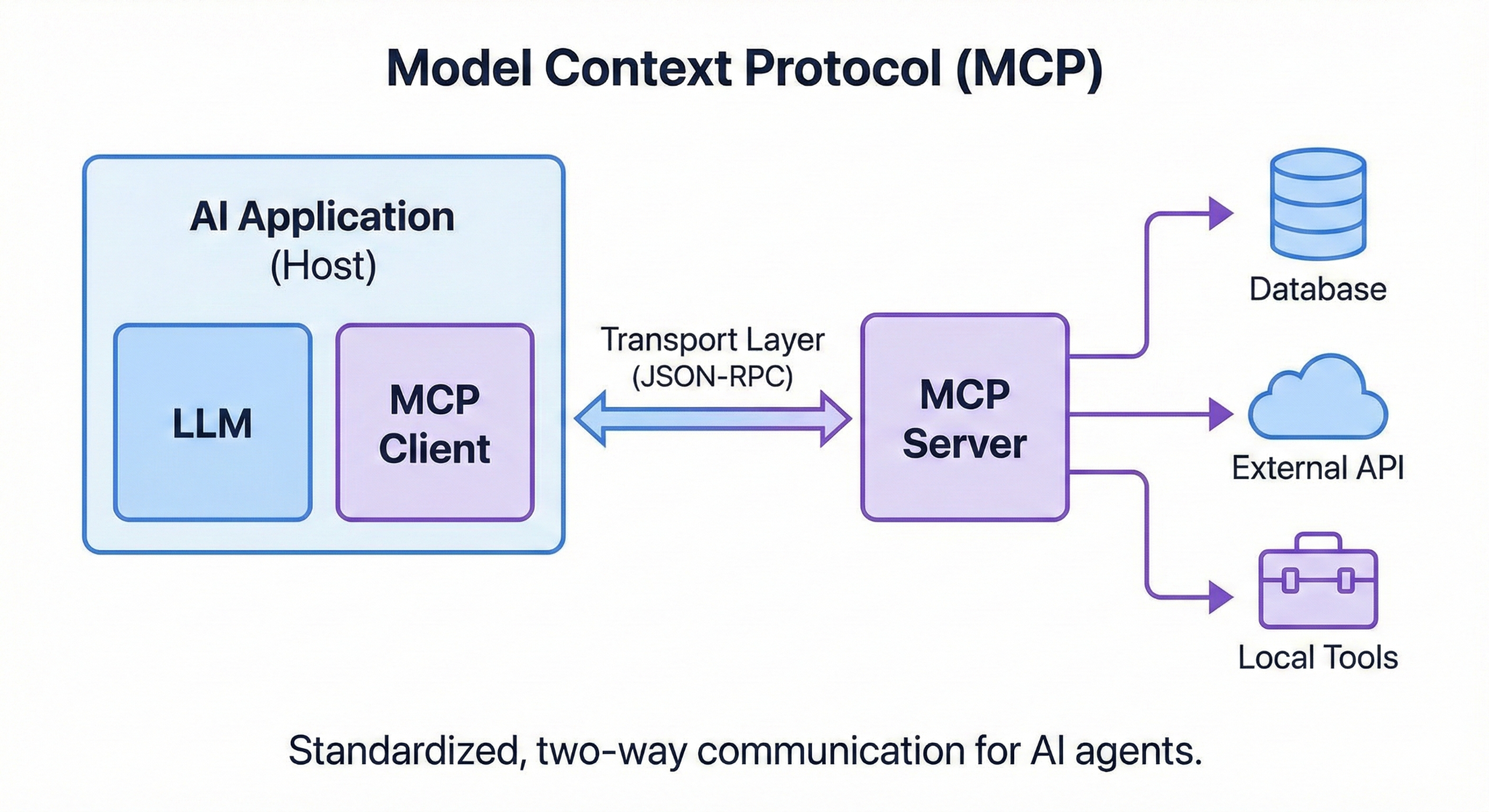
MCP operates on a client-server architecture, establishing a standardised two-way communication channel between the AI application and external resources.

  • MCP Host: The AI application itself (e.g., a chatbot or an AI-powered IDE) where the LLM resides and interacts with the user.
  • MCP Client: A component within the host that acts as the translator. It takes the LLM’s natural language intent and converts it into a structured MCP request.
  • MCP Server: A lightweight service that sits in front of your data sources or tools. It understands MCP requests and can execute them against the backend system (e.g., running a SQL query or calling a REST API).
  • Transport Layer: The communication channel (typically using JSON-RPC messages) over which the client and server exchange information.

The diagram below illustrates this elegant and modular flow.

Solving the “Smart but Disconnected” Problem

MCP directly addresses several critical challenges that have held back the deployment of truly useful enterprise AI:

  1. Fragmented Integration Workflows: Instead of building and maintaining dozens of custom connectors for your CRM, ERP, databases, and internal tools, you build a single MCP server for each. Any MCP-compliant AI client can then instantly interact with them.
  2. Reduced Hallucinations: By giving the LLM direct access to ground-truth data in your systems, you significantly reduce the chance of it making up information. The model can cite its sources, increasing trust.
  3. Increased AI Utility & Automation: MCP transforms an LLM from a passive knowledge retrieval system into an active agent. It can’t just tell you about a problem; it can be granted the tools to fix it, from resetting a password to reordering inventory.
  4. Standardised Context Handling: MCP provides a structured approach for defining and passing context. This ensures that different teams and systems are “speaking the same language” when providing information to the model, reducing errors and inconsistencies.

Navigate with Care: New Challenges Introduced by MCP

While powerful, opening up your internal systems to an AI model introduces new risks that must be managed carefully:

  • Security Risks: Giving an LLM the ability to execute code or query databases is a high-stakes game. Malicious actors could try “prompt injection” attacks to trick the model into performing unauthorised actions. Robust permissions, sandboxing, and human-in-the-loop verification are essential.
  • Identity and Access Management: It can be unclear whose identity the AI assumes when it takes an action. Is it acting as the user, or as a system agent? Clear identity propagation and auditing are crucial for compliance and security.
  • Token Consumption & Cost: Every piece of context sent back and forth between the client and server consumes tokens. For complex workflows with large datasets, this can quickly drive up costs and increase latency.

MCP vs. The World: Alternatives Compared

MCP is not the only way to give an LLM access to external information. It’s important to understand how it compares with other popular techniques, such as Retrieval-Augmented Generation (RAG).

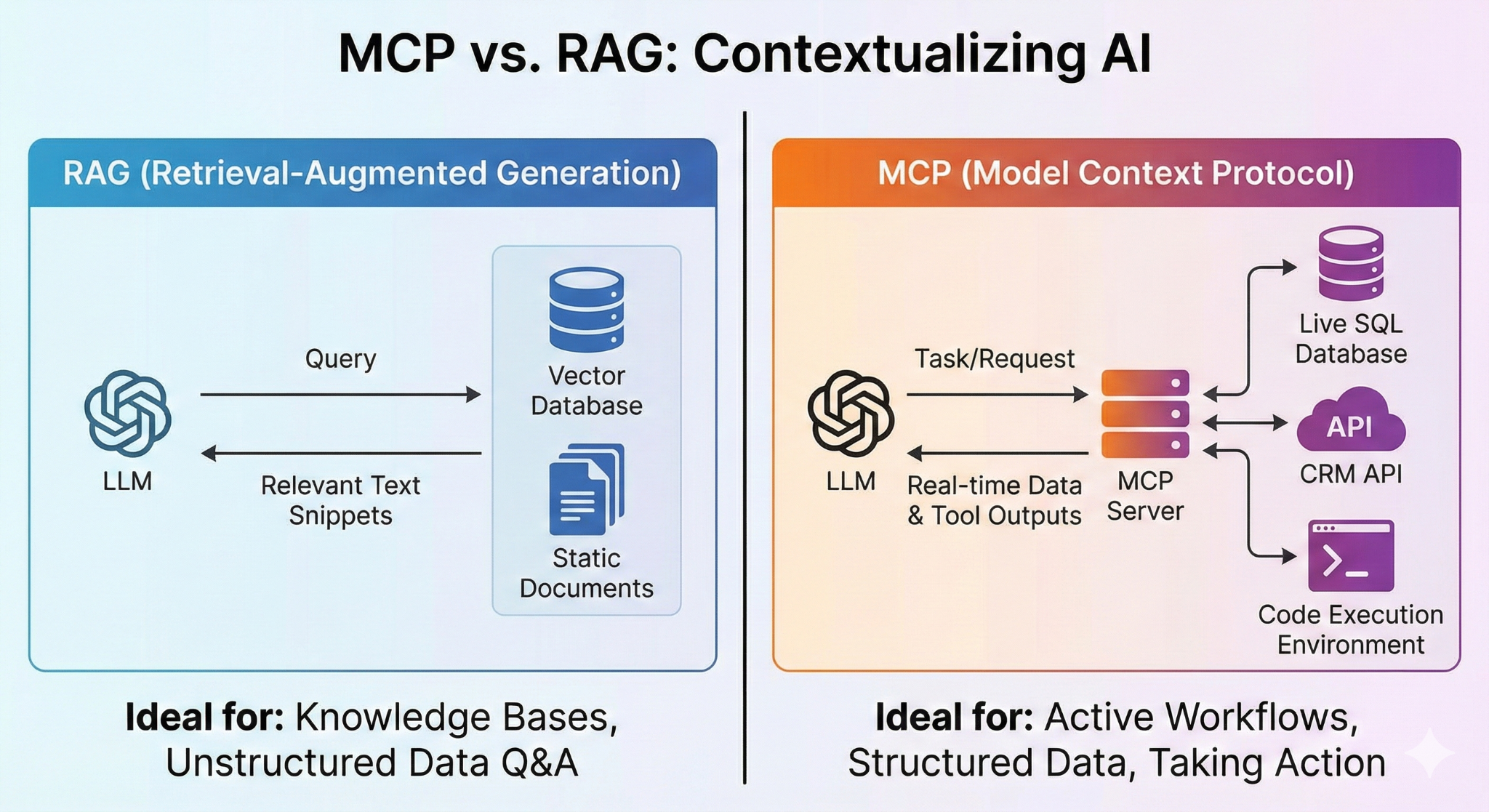
RAG is primarily designed to retrieve static, unstructured data from knowledge bases (e.g., PDFs or wikis) via semantic similarity. It’s great for answering the question “What does our policy say about X?”

MCP is designed for dynamic, structured data and active tool use. It’s the right choice for tasks like “find the live status of order #12345 from the SQL database and email the customer.”

While they can be used together, they solve fundamentally different problems. The image below provides a clear comparison.

The Enterprise Verdict: When to Use MCP

MCP is a game-changer, but it’s not a one-size-fits-all solution.

It’s a great fit when:

  • You need to connect AI to diverse, siloed internal systems.
  • Your use case requires real-time data access and the ability to take action, not just retrieve information.
  • You want to build “agentic” workflows where the AI can reason and execute multi-step tasks.

It might not be the best fit when:

  • You have a very simple, stateless integration where a full protocol is overkill.
  • Extreme low latency is paramount, and the protocol’s overhead could be an issue.
  • Your team is not ready to manage the security risks of giving an AI agent access to internal tools.

As the ecosystem matures, MCP is poised to become the standard for building truly connected and capable AI agents. By understanding its power and its pitfalls, enterprises can unlock a new level of automation and intelligence.

[1]: What is Model Context Protocol (MCP)? A guide – Google Cloud

[2]: Specification – Model Context Protocol

[3]: What problems does Model Context Protocol (MCP) solve for AI developers? – Milvus

Implementing Granular Access Control in RAG Applications

A Guide to Implementing Granular Access Control in RAG Applications

Audience: Security Architects, AI/ML Engineers, Application Developers

Version: 1.0

Date: 11 September 2025


1. Overview

This document outlines the technical implementation for enforcing granular, “need-to-know” access controls within a Retrieval-Augmented Generation (RAG) application. The primary mechanism for achieving this is through metadata filtering at the vector database level, which allows for robust Attribute-Based Access Control (ABAC) or Role-Based Access Control (RBAC). This ensures that a user can only retrieve information they are explicitly authorised to access, even after the source documents have been chunked and embedded.


2. Core Architecture: Metadata-Driven Access Control

The solution architecture is based on attaching security attributes as metadata to every data chunk stored in the vector database. At query time, the system authenticates the user, retrieves their permissions, and constructs a filter to ensure that the vector search is performed only on the subset of data to which the user is permitted access.


3. Step-by-Step Implementation

3.1. Data Ingestion & Metadata Propagation

The integrity of the access control system is established during the data ingestion phase.

  1. Define a Metadata Schema: Standardise the security tags. This schema should be expressive enough to capture all required access controls.
  • Example Schema:
  • doc_id: (String) Unique identifier for the source document.
  • classification: (String) e.g., ‘SECRET’.
  • access_groups: (Array of Strings) e.g., [‘NTK_PROJECT_X’, ‘EYES_ONLY_LEADERSHIP’].
  • authorized_users: (Array of Strings) e.g., [‘user_id_1’, ‘user_id_2’].
  1. Ensure Metadata Inheritance: During the document chunking process, it is critical that every resulting chunk inherits the complete metadata object of its parent document. This ensures consistent policy enforcement across all fragments of a sensitive document.
    Conceptual Code:
    Python
    def process_document(doc_path, doc_metadata):
        chunks = chunker.split(doc_path)
        processed_chunks = []
        for i, chunk_text in enumerate(chunks):
            # Each chunk gets a copy of the parent metadata
            chunk_metadata = doc_metadata.copy()
            chunk_metadata[‘chunk_id’] = f”{doc_metadata[‘doc_id’]}-{i}”
            processed_chunks.append({
                “text”: chunk_text,
                “metadata”: chunk_metadata
            })
        return processed_chunks

3.2. Vector Storage

Modern vector databases natively support metadata storage. This feature must be utilised to store the security context alongside the vector embedding.

  1. Generate Embeddings: Create a vector embedding for each chunk’s text.
  2. Upsert with Metadata: When writing to the vector database, store the embedding, a unique chunk ID, and the whole metadata object together.
    Conceptual Code (using Pinecone SDK v3 syntax):
    Python
    # 'vectors' is a list of embedding arrays
    # 'processed_chunks' is from the previous step

    vectors_to_upsert = []
    for i, chunk in enumerate(processed_chunks):
        vectors_to_upsert.append({
            "id": chunk['metadata']['chunk_id'],
            "values": vectors[i],
            "metadata": chunk['metadata']
        })

    # Batch upsert for efficiency
    index.upsert(vectors=vectors_to_upsert)

3.3. Query-Time Enforcement

Access control is enforced dynamically with every user query.

  1. User Authentication & Authorisation: The RAG application backend must integrate with an identity provider (e.g., Active Directory, LDAP, or OAuth provider) to securely authenticate the user and retrieve their group memberships or security attributes.
  2. Dynamic Filter Construction: Based on the user’s attributes, the application constructs a metadata filter that reflects their access rights.
  3. Filtered Vector Search: Execute the similarity search query against the vector database, applying the constructed filter. This fundamentally restricts the search space to only authorised data before the similarity comparison occurs.
    Conceptual Code:
    Python
    def execute_secure_query(user_id, query_text):
        # Authenticate user and get their permissions
        user_permissions = identity_provider.get_user_groups(user_id)
        # Example: returns ['NTK_PROJECT_X', 'GENERAL_USER']

        query_embedding = embedding_model.embed(query_text)

        # Construct the filter
        # This query will only match chunks where 'access_groups' contains AT LEAST ONE of the user's permissions
        metadata_filter = {
            "access_groups": {"$in": user_permissions}
        }

        # Execute the filtered search
        search_results = index.query(
            vector=query_embedding,
            top_k=5,
            filter=metadata_filter
        )

        # Context is now securely retrieved for the LLM
        return build_context_for_llm(search_results)


4. Secondary Defence: LLM Guardrails

While metadata filtering is the primary control, output-level guardrails should be implemented as a defence-in-depth measure. These can be configured to:

  • Block Metaprompting: Detect and block queries attempting to discover the security structure (e.g., “List all access groups”).
  • Prevent Information Leakage: Scan the final LLM-generated response for sensitive keywords or patterns that may indicate a failure in the upstream filtering.